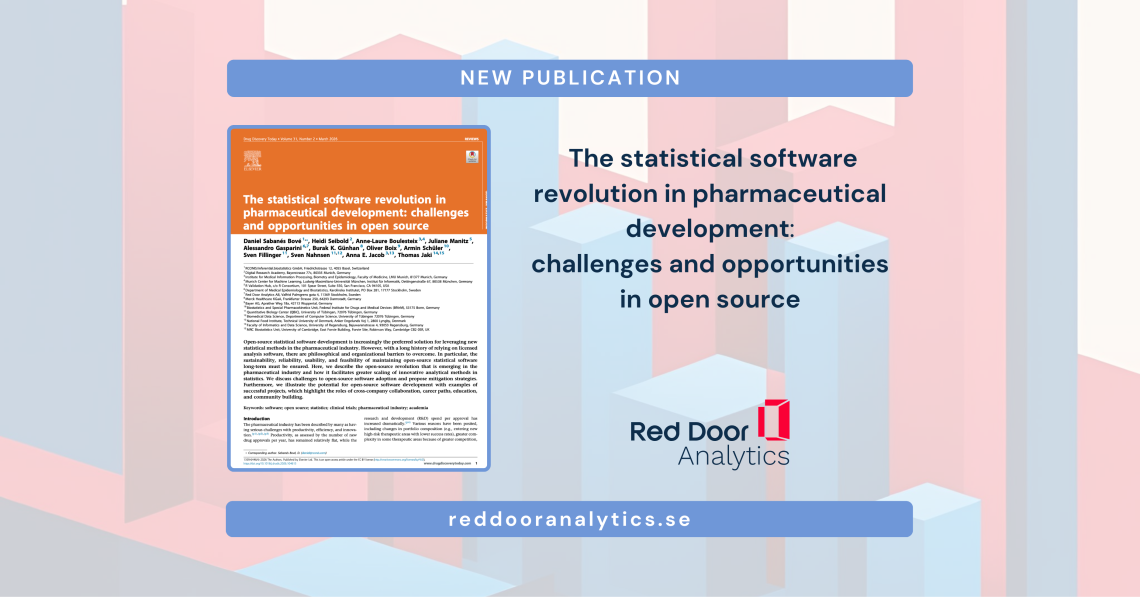
Check out the latest position piece published in Drug Discovery Today on the use of open-source software in the pharmaceutical industry—a topic of growing importance as the sector undergoes a major transformation in how statistical analyses are conducted and validated. As part of his work at Red Door Analytics, Dr Alessandro Gasparini contributed to this publication in his position as one of the co-chairs of the openstatsware group. Check out the interview with Alessandro below to learn more about his views on the advantages and challenges of open-source software in the pharmaceutical industry, and read the full article here.
Three questions to Alessandro
What are the benefits of transitioning to open source software?
Transitioning to open-source statistical software allows the pharmaceutical industry to rapidly adopt and scale methodological innovations required for complex clinical trials, while ensuring transparency for key stakeholders.
The shift also enhances efficiency by reducing the redundant costs of maintaining proprietary analysis pipelines, and sharing the burden of software development, testing, validation, and maintenance across organisations. Collaborative ecosystems and efforts ensure the long-term sustainability of key software packages, ultimately delivering medical products to patients more quickly and cost-effectively.
What ar the disadvantages of transitioning to open source software?
The transition to open-source still faces several challenges and disadvantages.
A major challenge is the philosophical resistance rooted in the industry’s reliance on proprietary software, mostly due to validation, certification, and regulatory issues. Moreover, senior leadership often argues that software development is not their core business, leading to a reluctance to shift resources away from drug development.
Technical and resource hurdles also present challenges, particularly the lack of software engineering skills among classically trained statisticians and statistical programmers. Developing and maintaining high-quality statistical software requires deep software engineering skills, but recruiting and retaining key talent is resource-intensive due to strong competion, e.g., from the tech industry.
Finally, ongoing concerns regarding long-term sustainability and reliability of community-driven tools still persist.
What is the way forward for open source software in the pharmaceutical industry?
The way forward for open-source software in the pharmaceutical industry involves a strategic shift towards sustainable software engineering practices and collaboration across organisations. In the paper, we highlight four key pillars that will contribute to success: professionalising research software engineers and upskilling current and future statisticians, overcoming barriers and skepticisms within organisations, enhancing the collaborative ecosystem, and standardizing quality and maintenance.
Open-source is already proving that it can fit the rigorous processes of both pharmaceutical companies and regulators, with successful submission packages by companies such as Roche and Novo Nordisk, and the successful pilot projects by the R Submissions Working Group.
Moreover, initiatives such as openstatsware and the pharmaverse already proved that pan-industry collaboration and software development efforts are not only possible but also robust and sustainable.
Publication details
Sabanés Bové D, Seibold H, Boulesteix AL, Manitz J, Gasparini A, Günhan BK, Boix O, Schüler A, Fillinger S, Nahnsen S, Jacob AE, Jaki T. The statistical software revolution in pharmaceutical development: challenges and opportunities in open source. Drug Discovery Today 2026.
Specialist subjects
Clinical Trial Services

Specialist subjects
Methods Development
Specialist subjects