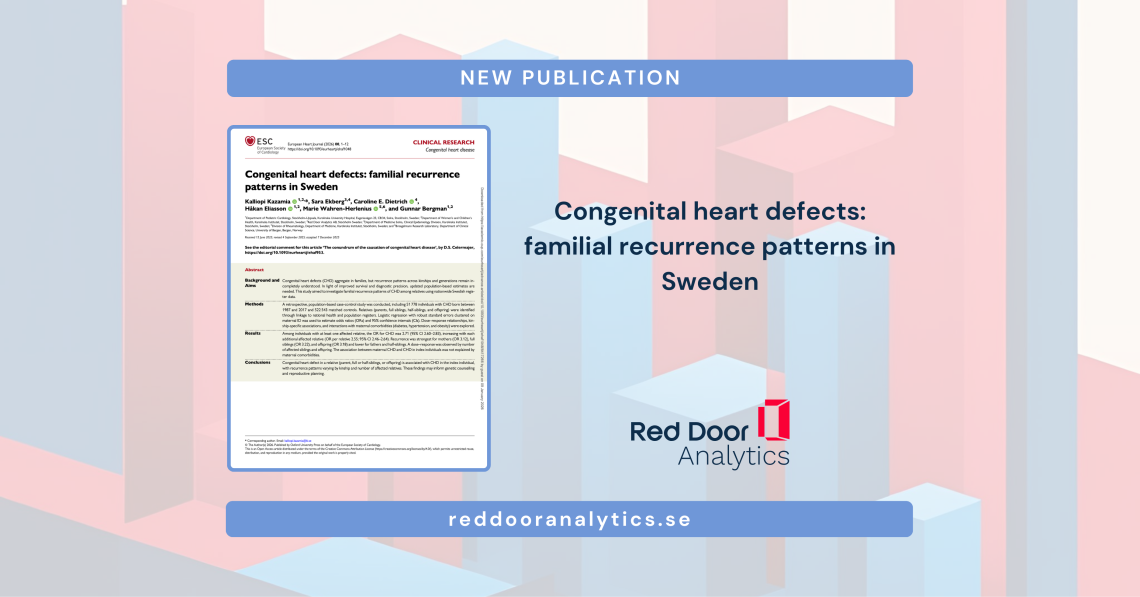
In our latest publication we used Swedish register data to examine familial aggregation of congenital heart defects (CHD) across kinships and generations. The authors found clear dose-response patterns between CHD risk and the number of affected relatives. Recurrence patterns varied by kinship type and degree of genetic relatedness, with the strongest associations observed among mothers, full siblings, and offspring – whilst more modest associations were found for fathers and half-siblings, supporting both genetic and potential maternal-specific mechanisms.

Three Questions to Sara

What was the most interesting part of this project for you?

For me, the most interesting part was being able to study familial aggregation of congenital heart defects at such a scale and level of detail. By linking nationwide health registers with the Swedish Multi-Generation Register, we could examine CHD across different types of relatives, across generations, and by the number of affected family members. What I found particularly compelling was how consistently the same patterns appeared across analyses. Seeing these patterns emerge again and again gave us confidence that we were capturing real familial signals rather than random variation, and that the observed gradients reflected meaningful familial and biological processes.

In this project you used the Swedish multi-generation register to study CHD across generations. How does the Swedish multi-generation register work and what can it be used for?

The Swedish Multi-Generation Register links individuals born in Sweden to their biological parents and, through them, to siblings, half-siblings, and offspring. Because every resident is assigned a unique personal identity number, these family links can be combined with national health registers. A key strength of the register is its near-complete coverage of the Swedish population over several decades, which helps minimize selection bias.

In practice, this allows us to construct very large family networks spanning multiple generations and to study how diseases cluster within families at the population level. The register is not limited to study congenital heart disease; when linked to national health registers, it can be used to study intergenerational patterns for a wide range of conditions, for instance chronic diseases, cancer, autoimmune diseases, and psychiatric disorders.

What is the key takeaway from this publication?

Overall, the findings show that congenital heart defects cluster within families in a systematic way. The likelihood of CHD increases with both the number of affected relatives and the degree of genetic relatedness, demonstrating a clear dose–response relationship. The strongest associations were observed among mothers, full siblings, and offspring, while more modest associations were seen for fathers and half-siblings. Together, these findings underscore the importance of detailed family history and maternal health when assessing familial CHD risk, and provide population-based evidence of how familial recurrence varies across kinships and generations.

Publication details

Kazamia K, Ekberg S, Dietrich CE, Eliasson H, Wahren-Herlenius M, Bergman G
Congenital heart defects: familial recurrence patterns in Sweden
European Heart Journal (2026)

Specialist subjects

Clinical Trial Services
Clinical Trial Services Biostatistics services of RDA are the cornerstone of clinical trial design, execution, and interpretation. Biostatistical support by RDA will ensure that your clinical development programme and inherent studies are scientifically rigorous, appropriately powered, and capable of generating reliable evidence for regulatory approval and clinical use. RDA’s expertise for clinical development is focused […]
Read more

Specialist subjects

Methods Development
Methods Development We provide expert guidance in finding the appropriate statistical approach to answer your question… and if there isn’t yet a method, well, we can develop one. While applying biostatistics to address your research question is essential, there may be times when existing methods fall short for your specific problem. In such cases, we’re […]
Read more

Specialist subjects

Applied Biostatistics

Applied Biostatistics Biostatistics plays a crucial role in advancing medical research. Whether it’s clinical trials, epidemiological studies, or pre-clinical research, biostatistics is essential for drawing meaningful, impactful conclusions from complex data. Our team consists of internationally recognized experts in applied biostatistics, with deep experience in a wide range of areas such as survival analysis, multi-state […]
Read more

Specialist subjects

Haematology

Haematological malignancies At Red Door Analytics, we have extensive experience in working with haematological malignancies, demonstrated through 18 publications in peer-reviewed journals. Our expertise spans epidemiological studies on prognosis and late effects, as well as randomised clinical trials. Based in Stockholm, we have unique experience in accessing and working with registry data from the Nordic […]
Read more

Videos

Introduction to Epidemiological Study Designs

This video offers a comprehensive introduction to epidemiological study designs, emphasising their classification, key definitions, strengths, limitations, and practical applications. We will dive into the most commonly used study designs, exploring their structure, purpose, and the contexts in which they are most effective. Throughout the video, real-world case studies of landmark research will be used […]
Read more

Specialist subjects

Real-World Evidence (RWE)

Real-World Evidence Real-world evidence (RWE) refers to data and information that, unlike data generated in clinical trials conducted in controlled environments, has been obtained from everyday clinical practice, patient registers, or other sources outside the clinical trial setting. RWE plays a crucial role in complementing traditional clinical trial data, providing insights into the safety, effectiveness, […]
Read more

Videos

State-of-the-art statistical models for modern HTA

At @RedDoorAnalytics, we develop methodology and software for efficient modelling of biomarkers, measured repeatedly over time, jointly with survival outcomes, which are being increasingly used in cancer settings. We have also developed methods and software for general non-Markov multi-state survival analysis, allowing for the development of more plausible natural history models, where patient history can […]
Read more

Videos

Multilevel (hierarchical) survival models: Estimation, prediction, interpretation

Hierarchical time-to-event data is common across various research domains. In the medical field, for instance, patients are often nested within hospitals and regions, while in education, students are nested within schools. In these settings, the outcome is typically measured at the individual level, with covariates recorded at any level of the hierarchy. This hierarchical structure […]
Read more

Statistical Primers

What are competing risks?

Competing risks In survival analysis, competing risks refer to the situation when an individual is at risk of experiencing an event that precludes the event under study to occur. Competing risks commonly occur in studies of cause-specific mortality, as all other causes of death than the one under study might happen before the individuals “have […]
Read more

Statistical Primers

What is immortal time bias?

Immortal time bias Immortal time bias is a type of bias that can occur in observational research when the study design allows for a period of time during which the outcome of interest cannot occur, often referred to as “immortal time”. Simply put, immortal time bias occurs when information from a future event is incorporated into the […]
Read more

Statistical Primers

What is the proportional hazards assumption?

Proportional hazards Proportional hazards in survival analysis means that the rate at which an event of interest occurs over time for two or more groups or individuals is proportional over time. Specifically, it assumes that the hazard ratio, which represents the relative rate of an event occurring between two groups or individuals, is constant over […]
Read more

Statistical Primers

What is censoring?

Censoring refers to a situation in survival analysis where the event of interest is not observed for some of the individuals under study. In this Statistical Primer, we’ll define three types of censoring often seen in survival analysis studies. Censoring occurs when the information on the survival time is incomplete or only partially observed. Censoring […]
Read more