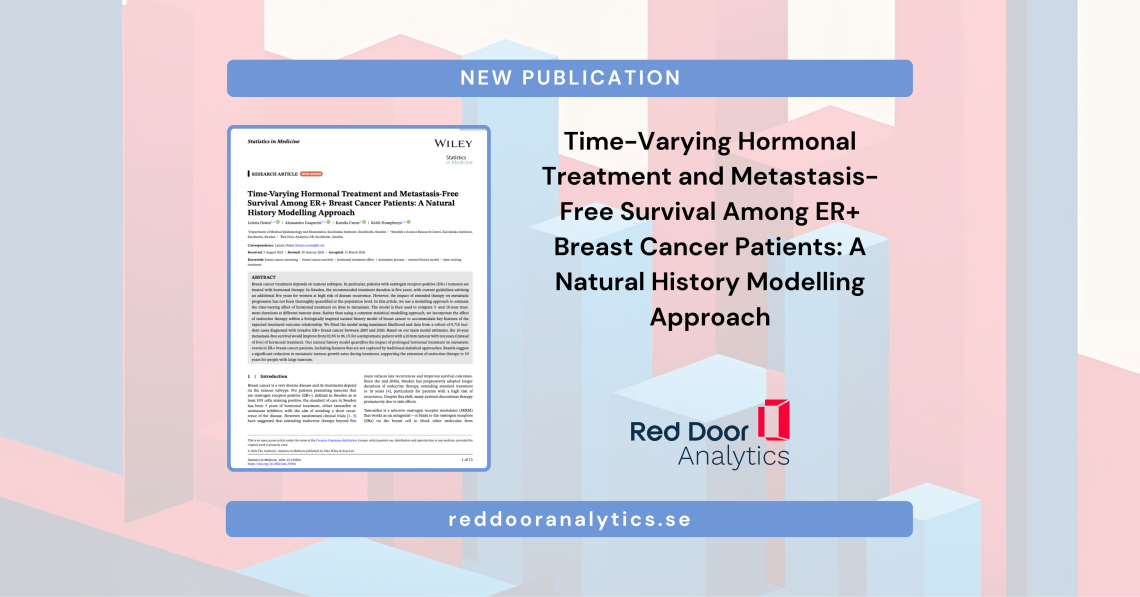
In this recent article, the authors present a biologically motivated natural history model of tumour growth and metastatic progression that directly incorporates the effects of hormonal therapy. By embedding treatment within the mathematical framework, the model captures treatment duration, latent metastatic growth, and the seeding process in ways that traditional statistical methods cannot.
The work is motivated by a key clinical question: how does extending endocrine therapy from 5 to 10 years affect metastasis‑free survival in oestrogen receptor–positive (ER+) breast cancer? Using data from nearly 10,000 incident ER+ breast cancer cases in the Stockholm–Gotland region in Sweden, the model quantifies how treatment slows metastatic growth over time.
The findings point to a meaningful reduction in metastatic tumour growth rates during therapy, translating into improved metastasis‑free survival—particularly for patients with larger tumours. These results support extending endocrine therapy to 10 years for individuals at higher risk of metastatic progression.
Publication details
Orsini L, Gasparini A, Czene K, Humphreys K. Time-Varying Hormonal Treatment and Metastasis-Free Survival Among ER+ Breast Cancer Patients: A Natural History Modelling Approach. Statistics in Medicine 2026.

Specialist subjects
Clinical Trial Services

Specialist subjects
Methods Development
Specialist subjects