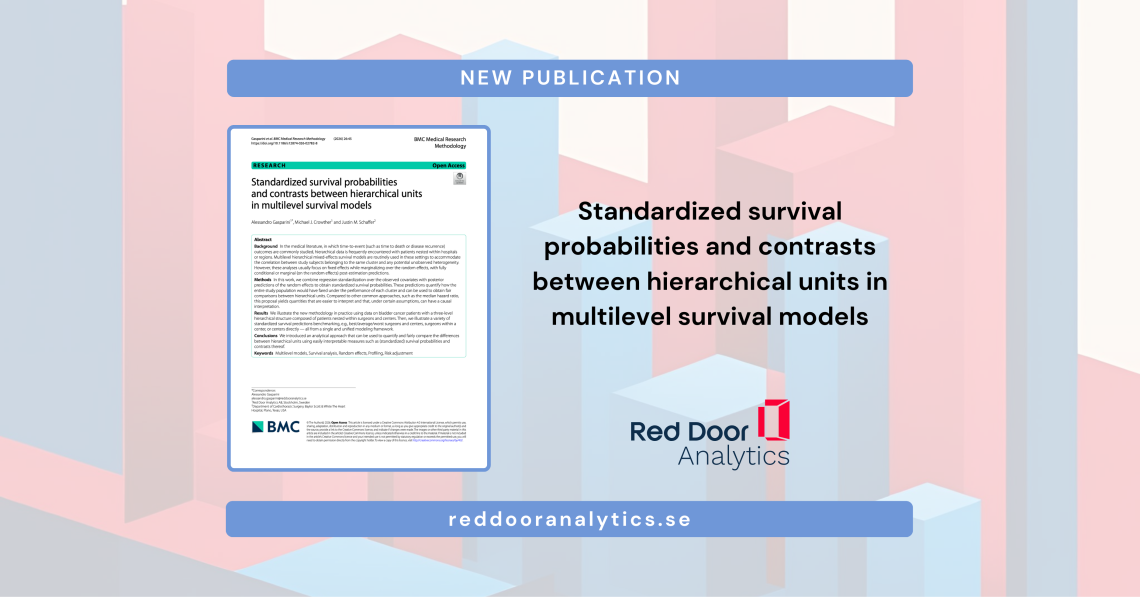
In our latest publication, we developed a new methodological approach to obtain fair comparisons of survival probabilities (and differences thereof) across study clusters such as hospitals, regions or other hierarchical units. The proposed approach combines posterior prediction of the random effects with regression standardisation to account for differences in the case-mix distribution between the clusters. We also developed an accompanying Stata command, available on our company’s GitHub page.

Three Questions to Alessandro

What was the most interesting part of this project for you?

The most interesting part of this project, for me, was to start with a substantive application and develop the methodology from the ground up to answer that question. In fact, we are currently working on this application – so stay tuned for that!

We were inspired by similar work in the settings of standard linear mixed effects models (i.e., for continuous outcomes), and further developed the methodology to accommodate survival outcomes. Finally, the software development part was very rewarding, as we developed a user-friendly Stata command that other researchers could use to apply the methodology in practice.

Can you give us a short summary of the paper, including the main takeaways?

The paper combines regression standardisation with posterior predictions of the random effects in multilevel (hierarchical) survival models to produce standardised survival probabilities that allow for fair and interpretable comparisons between hierarchical units (e.g., different surgeons or hospitals). These standardised predictions quantify how the entire study population would have fared under the performance of a specific cluster, e.g., “what if the entire study population was exposed to the level of care of a certain hospital”. By adjusting for and standardising over a common case mix (i.e., the characteristics of patients being treated), these differences are accounted for and predictions for different clusters can be compared fairly.

The method is demonstrated using a three‑level dataset (with patients nested within surgeons nested within centres), and we show how the methodology could be used to benchmark best/worst/average providers, compare surgeons within a centre, compare centres directly, and compute contrasts (which can be interpreted as risk differences) between units, all from a single, unified model.

Can you share any thoughts about other potential applications in which this approach might be especially useful?

This approach could be valuable anywhere you need fair, risk‑based comparisons of higher‑level units while adjusting for individual case‑mix and censoring: examples include benchmarking hospitals or surgeons on time‑to‑readmission or survival after surgery, comparing schools or teachers on time‑to‑dropout; evaluating regional programs on time‑to‑employment; assessing manufacturing plants or machines on time‑to‑failure; and analysing multi‑centre studies or registries where centres and/or clinicians vary in performance. It also fits comparative‑effectiveness and quality‑improvement work (e.g., transplant centres), policy evaluations with time‑to‑event outcomes, and studies of neighbourhood or institutional effects on survival outcomes; these settings benefit from the method’s ability to fix cluster effects and standardise over the observed case‑mix.

Multilevel survival models are already used in many fields (such as medicine, public health, and education), so extending them with standardised survival probabilities at the cluster level naturally broadens their practical impact.

Publication details

Gasparini A, Crowther MJ, Schaffer JM. Standardized survival probabilities and contrasts between hierarchical units in multilevel survival models. BMC Medical Research Methodology 2026.
Specialist subjects

Clinical Trial Services

Clinical Trial Services Biostatistics services of RDA are the cornerstone of clinical trial design, execution, and interpretation. Biostatistical support by RDA will ensure that your clinical development programme and inherent studies are scientifically rigorous, appropriately powered, and capable of generating reliable evidence for regulatory approval and clinical use. RDA’s expertise for clinical development is focused […]
Read more

Specialist subjects

Methods Development
Methods Development We provide expert guidance in finding the appropriate statistical approach to answer your question… and if there isn’t yet a method, well, we can develop one. While applying biostatistics to address your research question is essential, there may be times when existing methods fall short for your specific problem. In such cases, we’re […]
Read more

Specialist subjects

Applied Biostatistics

Applied Biostatistics Biostatistics plays a crucial role in advancing medical research. Whether it’s clinical trials, epidemiological studies, or pre-clinical research, biostatistics is essential for drawing meaningful, impactful conclusions from complex data. Our team consists of internationally recognized experts in applied biostatistics, with deep experience in a wide range of areas such as survival analysis, multi-state […]
Read more

Specialist subjects

Haematology

Haematological malignancies At Red Door Analytics, we have extensive experience in working with haematological malignancies, demonstrated through 18 publications in peer-reviewed journals. Our expertise spans epidemiological studies on prognosis and late effects, as well as randomised clinical trials. Based in Stockholm, we have unique experience in accessing and working with registry data from the Nordic […]
Read more

Videos

Introduction to Epidemiological Study Designs

This video offers a comprehensive introduction to epidemiological study designs, emphasising their classification, key definitions, strengths, limitations, and practical applications. We will dive into the most commonly used study designs, exploring their structure, purpose, and the contexts in which they are most effective. Throughout the video, real-world case studies of landmark research will be used […]
Read more

Specialist subjects

Real-World Evidence (RWE)

Real-World Evidence Real-world evidence (RWE) refers to data and information that, unlike data generated in clinical trials conducted in controlled environments, has been obtained from everyday clinical practice, patient registers, or other sources outside the clinical trial setting. RWE plays a crucial role in complementing traditional clinical trial data, providing insights into the safety, effectiveness, […]
Read more

Videos

State-of-the-art statistical models for modern HTA

At @RedDoorAnalytics, we develop methodology and software for efficient modelling of biomarkers, measured repeatedly over time, jointly with survival outcomes, which are being increasingly used in cancer settings. We have also developed methods and software for general non-Markov multi-state survival analysis, allowing for the development of more plausible natural history models, where patient history can […]
Read more

Videos

Multilevel (hierarchical) survival models: Estimation, prediction, interpretation

Hierarchical time-to-event data is common across various research domains. In the medical field, for instance, patients are often nested within hospitals and regions, while in education, students are nested within schools. In these settings, the outcome is typically measured at the individual level, with covariates recorded at any level of the hierarchy. This hierarchical structure […]
Read more

Statistical Primers

What are competing risks?

Competing risks In survival analysis, competing risks refer to the situation when an individual is at risk of experiencing an event that precludes the event under study to occur. Competing risks commonly occur in studies of cause-specific mortality, as all other causes of death than the one under study might happen before the individuals “have […]
Read more

Statistical Primers

What is immortal time bias?

Immortal time bias Immortal time bias is a type of bias that can occur in observational research when the study design allows for a period of time during which the outcome of interest cannot occur, often referred to as “immortal time”. Simply put, immortal time bias occurs when information from a future event is incorporated into the […]
Read more

Statistical Primers

What is the proportional hazards assumption?

Proportional hazards Proportional hazards in survival analysis means that the rate at which an event of interest occurs over time for two or more groups or individuals is proportional over time. Specifically, it assumes that the hazard ratio, which represents the relative rate of an event occurring between two groups or individuals, is constant over […]
Read more

Statistical Primers

What is censoring?

Censoring refers to a situation in survival analysis where the event of interest is not observed for some of the individuals under study. In this Statistical Primer, we’ll define three types of censoring often seen in survival analysis studies. Censoring occurs when the information on the survival time is incomplete or only partially observed. Censoring […]
Read more