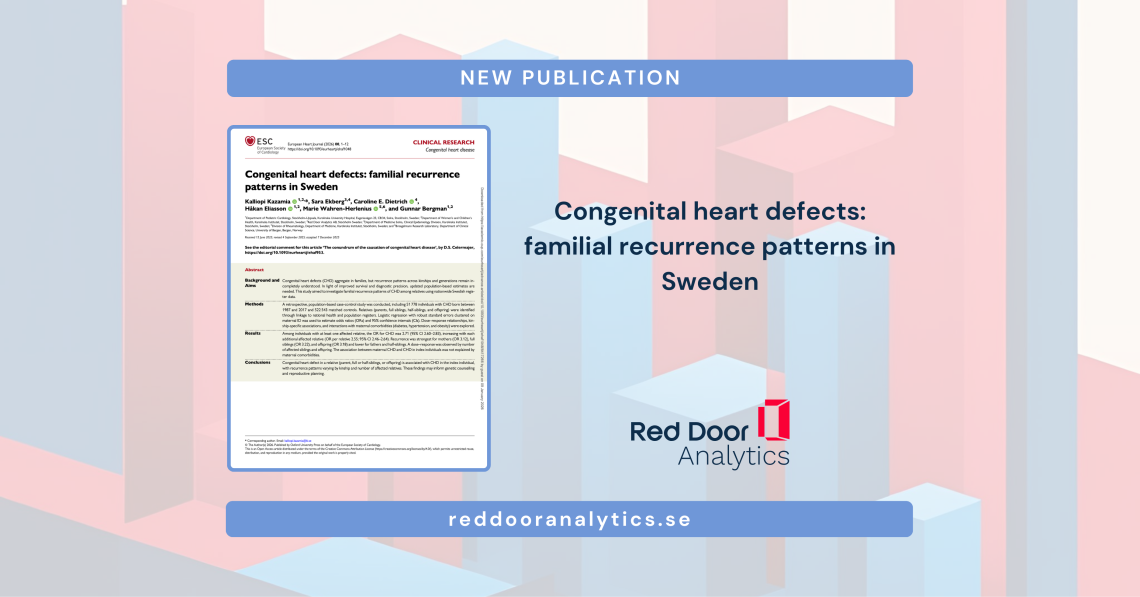
In our latest publication we used Swedish register data to examine familial aggregation of congenital heart defects (CHD) across kinships and generations. The authors found clear dose-response patterns between CHD risk and the number of affected relatives. Recurrence patterns varied by kinship type and degree of genetic relatedness, with the strongest associations observed among mothers, full siblings, and offspring – whilst more modest associations were found for fathers and half-siblings, supporting both genetic and potential maternal-specific mechanisms.
Three Questions to Sara
What was the most interesting part of this project for you?
For me, the most interesting part was being able to study familial aggregation of congenital heart defects at such a scale and level of detail. By linking nationwide health registers with the Swedish Multi-Generation Register, we could examine CHD across different types of relatives, across generations, and by the number of affected family members. What I found particularly compelling was how consistently the same patterns appeared across analyses. Seeing these patterns emerge again and again gave us confidence that we were capturing real familial signals rather than random variation, and that the observed gradients reflected meaningful familial and biological processes.
In this project you used the Swedish multi-generation register to study CHD across generations. How does the Swedish multi-generation register work and what can it be used for?
The Swedish Multi-Generation Register links individuals born in Sweden to their biological parents and, through them, to siblings, half-siblings, and offspring. Because every resident is assigned a unique personal identity number, these family links can be combined with national health registers. A key strength of the register is its near-complete coverage of the Swedish population over several decades, which helps minimize selection bias.
In practice, this allows us to construct very large family networks spanning multiple generations and to study how diseases cluster within families at the population level. The register is not limited to study congenital heart disease; when linked to national health registers, it can be used to study intergenerational patterns for a wide range of conditions, for instance chronic diseases, cancer, autoimmune diseases, and psychiatric disorders.
What is the key takeaway from this publication?
Overall, the findings show that congenital heart defects cluster within families in a systematic way. The likelihood of CHD increases with both the number of affected relatives and the degree of genetic relatedness, demonstrating a clear dose–response relationship. The strongest associations were observed among mothers, full siblings, and offspring, while more modest associations were seen for fathers and half-siblings. Together, these findings underscore the importance of detailed family history and maternal health when assessing familial CHD risk, and provide population-based evidence of how familial recurrence varies across kinships and generations.
Publication details
Kazamia K, Ekberg S, Dietrich CE, Eliasson H, Wahren-Herlenius M, Bergman G
Congenital heart defects: familial recurrence patterns in Sweden. European Heart Journal (2026).
Specialist subjects
Clinical Trial Services
Specialist subjects
Methods Development
Specialist subjects